Tips for male engagement

Regardless of the challenges facing us, one thing remains constant. Our kids need our support and encouragement at school and at home, possibly now more than ever.

There have always been barriers to achieving successful family engagement in general, and it seems there are even more barriers to achieving successful male engagement specifically. Some of those challenges are real and some are imagined, but both can be overcome with some of the same strategies and considerations.

In order to better understand how things have changed since COVID, and what some schools are doing to adapt, I wanted to talk with someone who has spent a few years being heavily involved and committed to increasing male engagement at the local and state levels.

James Strickland is a husband, father, and business owner. He and his wife Georgia have three children attending school at Katy ISD in Katy, Texas. Georgia is also a business owner and serves as Texas PTA Vice President Membership.

Katy ISD is a large school district with 70 schools and almost 89,000 students. In his role as the WATCH D.O.G.S. TOP DOG Extraordinaire, James has provided training and support for many of the 54 registered WATCH D.O.G.S. schools in Katy as well as regularly serving as a volunteer himself. Additionally, his role as Texas PTA Male Engagement Liaison has expanded his efforts and influence across the state.

During our conversation, James reiterated that he felt the most important thing a volunteer could do in this day and age is have their priorities in line. If your primary goal is to serve the kids and the school, then you will need to abide by whatever guidelines your school has provided.

The teachers and the administrators have tough jobs under the best of circumstances, and navigating the ever-challenging and ever-changing COVID protocols only make their jobs more difficult.

Please understand that no matter what guidelines the school district or the principal have in place, someone will disagree with them. Don’t volunteer unless you are willing to follow the current school protocols.

James said that Katy ISD made it easy for their parent volunteers to keep up with the current guidelines because they have several helpful links on their website. There you can see the current number of active cases in the school district, self report if you have tested positive, schedule a COVID test if you have symptoms or have had direct exposure, and view the school district’s complete plan for returning back to school safely.

We looked at a dozen school district websites from across the country, and every single one had information regarding COVID and the school’s current COVID protocols.

Many parents may not realize that their school district has provided excellent resources that will be vital to understanding the expectations of a volunteer. Be sure to utilize the COVID protocol information your district has provided and contact your principal’s office with any questions prior to volunteering.

Here are just a few do’s and don’ts for you to consider as a school volunteer, especially during these challenging times.

Do

  • Always know the current volunteer guidelines of your district and school. Especially regarding COVID, but also in general too.
  • Understand that your superintendent, principal, and teachers have the best interest of your student in mind, and every decision and rule they make is in serious consideration of their safety.
  • Have empathy for your superintendent, principal, and teachers, and don’t make their jobs even more difficult.
  • Agree to follow the prescribed COVID guidelines when you volunteer.
  • Always set a good example for the kids. Be cheerful and encouraging. We hear from educators regularly that the current situation is adding additional stress to many students. Your influence can make a huge difference in the quality of their school day.
  • Thank every person who works at the school when you have the opportunity. Certainly, the teachers and the principal, but also the secretary, school nurse, cafeteria staff, and custodians. Showing appreciation will make a huge difference.
  • Remember that family engagement at school begins at home. Make time every day to ask your child about school. Be aware of their social and academic successes and challenges.
  • Remember that the teachers and principal are your partners in your child’s education. Having a good relationship with them will make everything flow a little easier and contribute to the best possible outcomes for your child.
  • Make volunteering a priority. Regular volunteers are some of the busiest people we know, and they always have somewhere else they could be, they just made the time to help others.

Don’t

  • Underestimate the power of simply showing up and asking how you can help.

The bottom line: we can continue to experience robust and effective family and community engagement in our schools, as long as we work together and keep the best interest of the kids in mind.

Our kids deserve the best educational conditions we can provide, and the support of the moms, dads and grandparents will make a huge contribution to a positive and productive learning environment. Make the commitment to volunteer today.


Eric Snow is the president and co-founder of WATCH D.O.G.S. (Dads of Great Students).

This article was originally published by National PTA.

How two PTAs are making waves with DEI

In January 2022, National PTA awarded grants to local PTAs to enhance Diversity, Equity and Inclusion practices in their schools and communities. Two PTAs in Texas won these grants, and we spoke to them about what DEI looks like on their campuses. Erika Bodoin is President of Bertha Casey Elementary School PTA in Austin ISD, and Meenal McNary is Equity, Diversity, and Inclusion Chair of Ridgeview Middle School PTA in Round Rock ISD. 

How it started:

Erika Bodoin thinks her PTA just got lucky. “We ended up having very equity-focused board members,” she said. The board members at Bertha Casey Elementary School PTA are constantly challenging themselves to see through an equity lens and asking, ‘whose voice is missing?’ In connecting with the district administration, teachers and parents, Bertha Casey Elementary School PTA is focusing on language access and community feedback.

Meenal McNary’s PTA started its DEI standing committee a couple of years ago. Ridgeview Middle School PTA chose to focus on three action areas of racial equity, special education and Genders and Sexualities Alliances. The PTA recently started hosting listening sessions called “Community Conversations” where they’ve been able to “really get down to the nitty-gritty about what [the community] needs PTA to do,” McNary said. “I don’t think you can fulfill every child’s potential unless you approach it with equity and unless you recognize lived experiences,” she said. Ridgeview Middle School PTA does just that. Notably, the PTA is helping the Genders and Sexualities Alliances group create a guide on common and acceptable language, hosting listening sessions with their diverse community and purchasing black-authored books from local bookstores.

What Bertha Casey Elementary and Ridgeview Middle schools have in common is that they both got early support from the campus and district administration. Specifically, both Bodoin and McNary have worked directly with their district equity departments. Specific district staff are dedicated to these efforts and have been supportive of the PTAs’ work.

How it’s going:

McNary says this work is a “long-time coming.” Ridgeview Middle School PTA is working to connect the dots between recognizing lived experiences and achieving the mission of PTA.

Through understanding the school demographic data, education gaps and racial makeup, both PTAs are growing to understand the direct needs of their communities.

With educators carrying such a heavy load, McNary and Bertha Casey Elementary School PTA focus on supporting and uplifting teachers to fill in the gaps and get closer to fulfilling every child’s potential. For Ridgeview Middle School PTA, this means providing resources and services that help teachers recognize when something is not equitable, fair or accessible.

Although progress can be slow, Bodoin says, “the DEI grant provides a structure for getting even more feedback from historically marginalized groups.” Bertha Casey Elementary School PTA uses that feedback to figure out where the association and school are coming up short. The PTA is considering spending the grant money on a globally understood unifier, food. To Bodoin, providing snacks or a meal at some of these community conversations has the potential to form a more welcoming and relaxed gathering.

Why DEI:

For McNary, it’s personal. “Based on personal experience, and what my children have dealt with in school, I feel that it’s important that children be seen and be heard. PTA’s mission that every child reaches their full potential, in my mind, was not being fulfilled. So, I wanted to change that,” she said. McNary and Ridgeview Middle School PTA started with changing the makeup of an all-white executive board – adding men and people of color.

For Bodoin, interest in DEI started in 2014 when she attended an “Undoing Racism” workshop. “It made me see that my dynamic on my campus was affected by me being a white woman,” she said. Through changing community demographics and a mostly brown executive board, Bodoin’s years of antiracism work took on new meaning.

For PTAs looking at starting DEI groups, McNary and Bodoin have some advice. Bodoin has found that the concept doesn’t typically need selling. She explained that people know that related work is needed. Starting DEI groups just requires a thoughtful approach.

Both McNary and Bodoin say that gaining administrator support and listening to the community are the keys to success. Both say that the PTA leaders they work with make a difference as well. “I’ve never worked with such amazing people, and it warms my heart to collaborate so closely with people who feel so strongly about this mission,” McNary said. Bodoin challenges PTAs to ask, ‘Do you feel like your leadership represents your community?’ If not, she encourages PTAs to figure out why.

Looking to the future, the PTAs at Bertha Casey Elementary and Ridgeview Middle schools are poised to have influence.


Texas and National PTA have extensive resources on diversity, equity, and inclusion. Check out txpta.org/dei, pta.org/dei and pta.org/grants to learn more.

The 400-Day Pause

I recently used my Instagram (@heydudeniceshoes) to ask students, “What do you wish parents and educators realized about this past year?” Here’s what some students had to say:

“In person school is hard when you aren’t allowed to be close to your friends.”

“All the things I looked forward to are gone and now it’s just work.”

“I have questions, but my mic doesn’t work, and they don’t read the chat.”

“We are scared too.”

“I prefer virtual math but not virtual choir.”

“I have to help my brothers with their work during the day.”

“My computer is slow.”

“I wish I could go to school face to face, but my mom is at risk so I can’t.”

“I am not lazy.”

“How is this my senior year?”

“I actually MISS normal class.”

“I have a hard time paying attention, but I am trying.”

One response really stuck with me. It was from a high school junior named Connor. He wrote, “I wish they realized that we didn’t imagine growing up like this. I’m seventeen on paper, but I still feel fifteen.”

I reached out to Connor and asked him to elaborate. He shared that he had not been inside his school since midway through sophomore year, right before we all hit pause. As we approach the 400-day mark of the pandemic, some of us are coming out of pause while others are waiting longer to press play. But for Connor, he will not be able to return to his school building until he’s a senior this fall.

Back in the spring of 2020, no longer a new guy on campus, Connor was still basking in the “seniority” one more grade afforded him. He was happy to put freshman year behind him, but he also couldn’t help marvel at all the stuff the upperclassmen could do – and that he was anticipating – like awards, dances, and games. Connor saw juniors receive their letter jackets and then parade around campus wearing them even on warm days. He assumed that his own letter jacket and any hoopla at school would come down the road.

But when his letter jacket arrived in the mail not too long ago, Connor realized just how much all that ceremony mattered. There was no one at home who wanted to see it, or read the patches, or watch him try it on. He had nowhere to wear it but his bedroom. The only hoopla he was able to share was on social media. “Pics or it didn’t happen,” he said on the post. Connor showed his parents later that day, who took a bunch of pictures as parents tend to do, but right into the closet it went after.

Connor is hopeful he will wear his letter jacket to school this fall for senior year. I am hopeful too.

When I think back to my sophomore year: Titanic was on the big screen. I had just bought Oasis’s third album on CD. My hair was a dark maroon. Revlon’s toast of New York was my go-to lipstick. And my favorite store was tied between Gadzooks and Contempo Casuals. I was very involved in both theater and speech and had a tight circle of friends.

I remember how much older the seniors seemed. They could drive cars, date, and get in big trouble. All those things seemed so far away to me. I hadn’t even taken drivers ed yet or had a boyfriend, and what on earth would I get in trouble for? Over the next two years, I learned the answer to that question.

With license in hand, I made good and bad decisions, got into trouble, and learned a few lessons along the way. I dated, had my heartbroken, and then moved on to love again. At 18, I was growing into another person. I no longer had maroon hair or shopped at Gadzooks. And I didn’t even audition for the school musical.

“We don’t know how these kids will pick up from where they left off — socially and developmentally.”

Yes, my life had changed, and I had too. But how different would things have looked if I was plucked out of sophomore year and then plunged back in as a senior? Would I have learned those lessons, grown from heartbreak, and gotten to know myself better? Would I have kept the maroon hair? We don’t have anything to compare this 400-day pause to. We don’t know how these kids will pick up from where they left off — socially and developmentally.

As we slowly follow the light at the end of the tunnel and prepare for next school year, we need to realize that kids right now lost over a year of their adolescence. The seventh grader we see this fall hasn’t really experienced middle school yet. And just like Connor, high school seniors may feel younger in some ways.

This long pause has caught me off guard as well. I was 38 when the pandemic began. And two weeks ago, I turned the big 4-0. This is usually a huge milestone for my family and friends. We’re talking trips, parties, and pictures – pics or it didn’t happen. But instead, I started a new decade under the radar – although very contently with my three favorite people and X Files reruns and take out.

I feel 40 as much as Connor feels like he’s 17.

Earlier during the pandemic, I heard one reporter say, “Same storm, different boat.” This rings very true. As we prepare for what’s next, I hope we realize that we are all coming from different places. Some of us have weathered the storm and some of us are still in it. Some of us are ready and some of us are not. For some people, 400 days is just the midway point.

I hope that we show each other grace, patience, and kindness. I hope that if someone is excited to talk, we listen. I hope that if someone sets a boundary, we honor it. I hope we see each other in the brightest and most hopeful light after this long 400-day pause – whenever you decide the time is right for you to hit play.

Be gentle my friends, as the storm ebbs and flows our boats may re-surface in varying degrees of disrepair. Whether you hit play after a 400-day pause or more like 600 days, I hope that day is everything you’ve waited for.

Road to Raising the Age

Michele Deitch has been talking about prison reform for more than 30 years. She’s an attorney and professor at the University of Texas schools of law and public affairs where she has written and contributed to numerous reports and articles and teaches courses on corrections, sentencing, and policy. She speaks publicly on the issue including a 2014 TEDx Talk titled “Why are we trying kids as adults?”


In 2007, Michele Deitch’s focus shifted to the juvenile justice system for two reasons. First, the Texas Youth Commission, the government agency responsible for juvenile corrections, faced a number of scandals including sexual violence against inmates and a number of administrative failures across the state.¹ Around the same time, Christopher Pittman was charged with two concurrent terms of thirty years imprisonment for murdering his grandparents in South Carolina.² Pittman was just 12-years-old at the time of the incident. Michelle worked closely with his lawyers during the appeal process as they argued that children shouldn’t be subject to the death penalty or lifelong sentences without the possibility of parole. Both situations triggered nationwide conversations about reinventing the juvenile justice system into something more rehabilitative.

Deitch and her students embarked on a major study to learn what happens to children under the age of 12 who enter the adult criminal justice system.

“It was a wake up call for me,” Deitch says. She was stunned by the number of kids in the adult system.

They began to take a closer look at the issues these minors tend to face in Texas and across the nation. The research showed that a substantial portion of cases that led to minors entering the adult system were those of 17-year-olds who are automatically treated as adults.

In fact, since the 1913 Juvenile Delinquency Court Act (which created the juvenile system in Texas), 17-year-olds have been automatically tried as adults regardless of the nature of their crimes.

Deitch knew then that raising the age of criminal responsibility from 17 to 18 would be paramount to addressing juvenile delinquency.

“If we wanted to make any difference in terms of keeping kids out of the adult system, it needed to be by raising the age of jurisdiction and saying that kids under the age of 18 should be in the juvenile system,” Deitch said.

Starting in the mid-2000’s and after 2010, states that had lowered the age of criminal responsibility to 17 began to raise it back to 18.

Deitch says, “They started to understand that kids are different from adults. Their brains aren’t fully developed; they are much less culpable for their offenses; and they’re much more susceptible to rehabilitation.”

Since then, Texas legislators have written and sponsored multiple bills which address raising the age. In fact, this legislation was considered in 2013, 2015, 2017, 2019, and a bill is already pre-filed for the 2021 session.

Adult Certification

Proposed raise the age legislation leaves in place the certification process by which any child (14 and up) can be moved to an adult court at the discretion of a judge. The supposed practical purpose of adult certification is to transfer teens who commit repeated or egregious crimes.

Over the years, Deitch’s research showed that even adult certification isn’t entirely fair in practice. She and her students found that kids were being transferred on their first offenses and for nonviolent crimes.

“The assumption is that we are only transferring the worst of the worst,” she said. “The assumptions didn’t match up with the reality.”

Despite issues with the way the statute on adult certification is written, Deitch believes that the tides are turning toward leniency and that judges are more cautious about who they certify.

Why Kids Don’t Belong in the Adult System

A study by the Centers for Disease Control and Prevention found that teens who are transferred from juvenile to adult courts are 34% more likely to be re-arrested for violent or other offenses than youth who are kept in the juvenile system.³

“They have enormously greater risk of suicide and of being physically or sexually assaulted in the adult system,” Deitch says. “They aren’t getting access to programs or services on the level that they would be on the juvenile side.”

Additionally, when 17-year-olds enter the adult system, their parents don’t have the right to be involved in the court process. In fact, law enforcement is not even required to inform parents of their arrest.

The vast majority of offenders aren’t going to prison, though. In 2018, about 78% of arrests of 17-year-olds were for nonviolent crimes which often result in probation. Deitch believes that the rules often included in adult probation can be extremely challenging for a teen to follow and raise much higher barriers to entering college and the workforce.

“They’re not going to have the range of programs and services they would have on juvenile probation,” Deitch said.

The Best Solution

Deitch would like to see the age of criminal responsibility raised to 18 and additional funding be added to support juvenile probation programs in the state.

If raise the age legislation passes, an influx of 17-year-olds will impact juvenile courts and probation systems. Deitch believes the courts need specialized programs for this population.

“Their needs are different from that of a 12 or 13-year-old.”

For those in doubt, Deitch says, “Its important for families to understand that raise the age doesn’t change transfer laws.” As with kids over 14, any 17-year-old who commits a truly heinous crime can be transferred to the adult system at the discretion of the court.

With so many teens committing minor crimes and offending for the first time, she believes this legislation will help reduce the number of kids entering and staying in the system.

“It’s basically stupid teens doing stupid teen stuff. And if they go into the adult system, it has a lifelong impact on them.”

What Now?

State Representative Gene Wu (District 137 in southwest Houston) has sponsored a pre-filed bill (House Bill 486) to be considered in the Texas House.

HB 486 (and most other similar bills) would raise the age of criminal responsibility from 17 to 18. If passed, the bill would become an act taking effect on September 1, 2021.

Raise the age is one of Texas PTA’s legislative priorities for the 87th Texas Legislature. To learn more visit www.txpta.org/legislative-priorities.

¹Highly recommended reading: https://www.texasmonthly.com/politics/sins-of-commission/
²Previous cases had begun to set precedent that kids are principally different from adults and shouldn’t be held to mandatory life sentences for crimes committed while they are children. More information on South Carolina vs Pittman: https://www.sccourts.org/opinions/displayOpinion.cfm?caseNo=26339
³Centers for Disease Control and Prevention, “Effects on Violence of Laws and Policies Facilitating the Transfer of Youth from the Juvenile to the Adult Justice System: A Report on Recommendations of the Task Force on Community Preventative Services. https://www.cdc.gov/mmwr/preview/mmwrhtml/rr5609a1.htm#fig

How Programming Develops Problem-Solving Skills in Children

You think there is life and there are problems. Two separate things. But in reality, they are inseparable. – Buddha

As a parent, you’re told that programming teaches children problem-solving skills, but few educators demonstrate how it does so. Using a childhood game, “rock paper scissors,” we’ll show you how coding naturally develops problem-solving skills in children.

The art of problem-solving

To see how programming teaches problem-solving, we must first understand what problem-solving skills are. We can break problem-solving skills into two connected skills: critical thinking and creativity.

Critical thinking is a kind of analysis that helps us understand the problem by breaking it down into simpler steps. Once we have deconstructed our problem into manageable chunks, we can logically organize the pieces and find a resolution. Through critical thinking, we can evaluate and dissect a problem, but actually solving the problem requires another skill, creativity.

Creativity is crucial because your critical thinking alone can’t give you a solution. Critical thinking can help you assess your ideas, but you have to come up with ideas yourself. Only after coming up with possible solutions can you compare solutions according to their efficiency, your goal, and the resources available.

The creative and critical thinking skills in problem-solving are not distinct. Creativity supplies the content and critical thinking will evaluate this content, neither can solve the problem alone. We learn problem-solving through practice. We have to try, fail, then try again to come up with solutions to problems. Programming is a perfectly safe environment for students to learn problem-solving.

How programming teaches kids the art of problem-solving

The “rock paper scissors” project at CodeWizardsHQ is a perfect example of how students develop problem-solving skills while learning programming. Students will:

1. Break down the game into smaller parts
2. Solve each small part, one by one
3. Repeat until each small part is solved

Kids break down a big problem into small problems

For this project, we initially ask students how they would use code to program the game “rock paper scissors.” The overwhelming reaction is “I don’t even know where to start!”. This is because to begin the program they have to think about the problem critically. Something young students may have never done.

What we’re really asking is, how do you play rock paper scissors? We ask them to deconstruct the game by thinking about it as a series of steps.

As soon as we teach them how to think about the problem, they can usually use that thought process to formulate these three steps:

Students solve problems using direct application of what’s taught in class

After the student has deconstructed this problem, they realize how breaking down a problem puts them in a much better position to solve it. Confusion turns to confidence as they have now figured out a starting point.

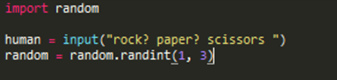
We then prompt them to take each of the steps or mini-problems and solve them one at a time. For the first step, the computer needs to ask the user to make a choice. Students will know how to solve this specific problem because one of the first things they learn in class is how to make the computer ask for input from the user.

For the second step in the game, the computer needs to choose from the same options presented to the user: rock, paper, or scissors. This step requires the student to think of a way for the computer to make a choice.

The student might think to themselves, “when I play rock paper scissors what the other person chooses is random to me.” Luckily, they already know how to write code that tells the computer to create a random number. It’s a common programming problem that has a standard solution. All they need to do now is connect the random number to the computer’s choice.

Students solve problems by applying what’s taught in a different context

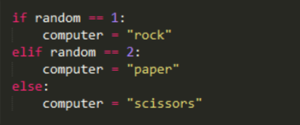
In our example, we’re using Python. In order to get a random choice, the computer must first generate a random number between 1 and 3. Students then program “if” statements that attach each potential number to one of the choices – rock, paper, or scissors. The computer now randomly picks from rock, paper, or scissors by generating a random number.

Students solve problems using logical thinking

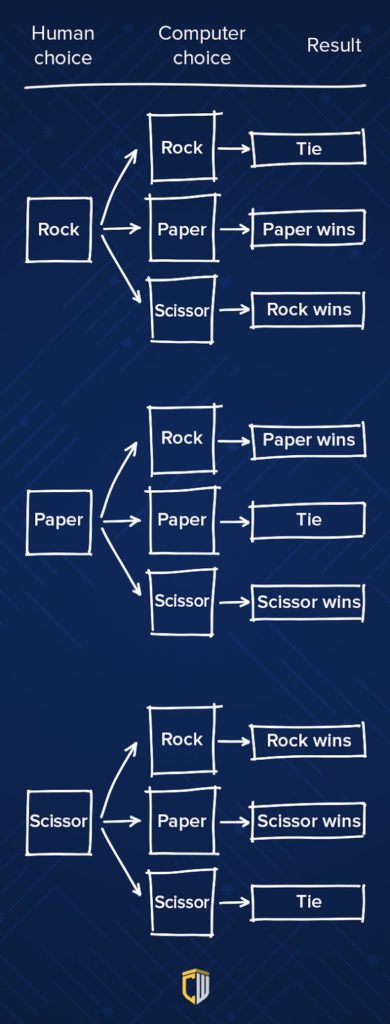
For the last step, they need the computer to decide who the winner is based on the choices made by the user and the computer. The computer will show a different output for each combination but, since students rarely practice organizing their thoughts, all of these combinations might feel jumbled in their heads. To solve this problem, we ask them to list each of the combinations and outcomes by organizing them in a logical drawing. With a little guidance, they end up with a decision tree like this.

For every user choice, the computer can randomly pick from three options. By extending that logic the student can organize three possible user choices with three corresponding computer choices each, a total of nine outcomes.

When we get students to tell us about how the computer reaches each outcome, they start to explain it in an “if-then” structure. “If I pick rock, and the computer picks scissors, then the computer outputs ‘rock wins’.” Transferring this logical “if-then” structure into code for each of the nine outcomes is just a matter of knowing the correct syntax.

The result in Python:

Our “rock paper scissors” game shows how students can go from not knowing where to start to completely solving a difficult problem using code. Programming forces students to exercise their critical thinking and problem-solving skills. It’s an exciting and fun way for students to learn and build on these skills.

The practice of breaking down problems, logically structuring solutions, and picking the best solution applies to more than coding. They are actively used in school and work. Students can build on what they learn while programming and applying these skills to the problems they face in everyday life.