
AI in Schools: What Families Need to Know

As artificial intelligence becomes a bigger part of students’ learning environments in visible ways and sometimes behind the scenes, families are asking important questions about what it means for learning, child development, and student safety. 

To help answer those questions, Texas PTA’s Straight Talk ’26 panel brought together experts in public education, technology and mental health to share practical insights about how AI is being used in schools, how it works, and where support and safeguards matter most.

How does AI show up in classrooms at the elementary, middle, and high school level?

Kyle Berger, chief technology officer for Arlington ISD, said many families are feeling uncertainty about AI and that schools are responding in different ways. He described the introduction of the tool in classrooms as a gradual, age-appropriate approach that helps students build familiarity with AI and use it more responsibly over time.

“I think it is pretty obvious to everybody there’s a lot of AI anxiety,” he said. “It’s showing up differently across schools because local responses vary. Some schools are saying they’ll block it all. Some schools are saying, ‘let’s be really careful and thoughtful.’ Some schools are saying, ‘let’s go all in.’” 
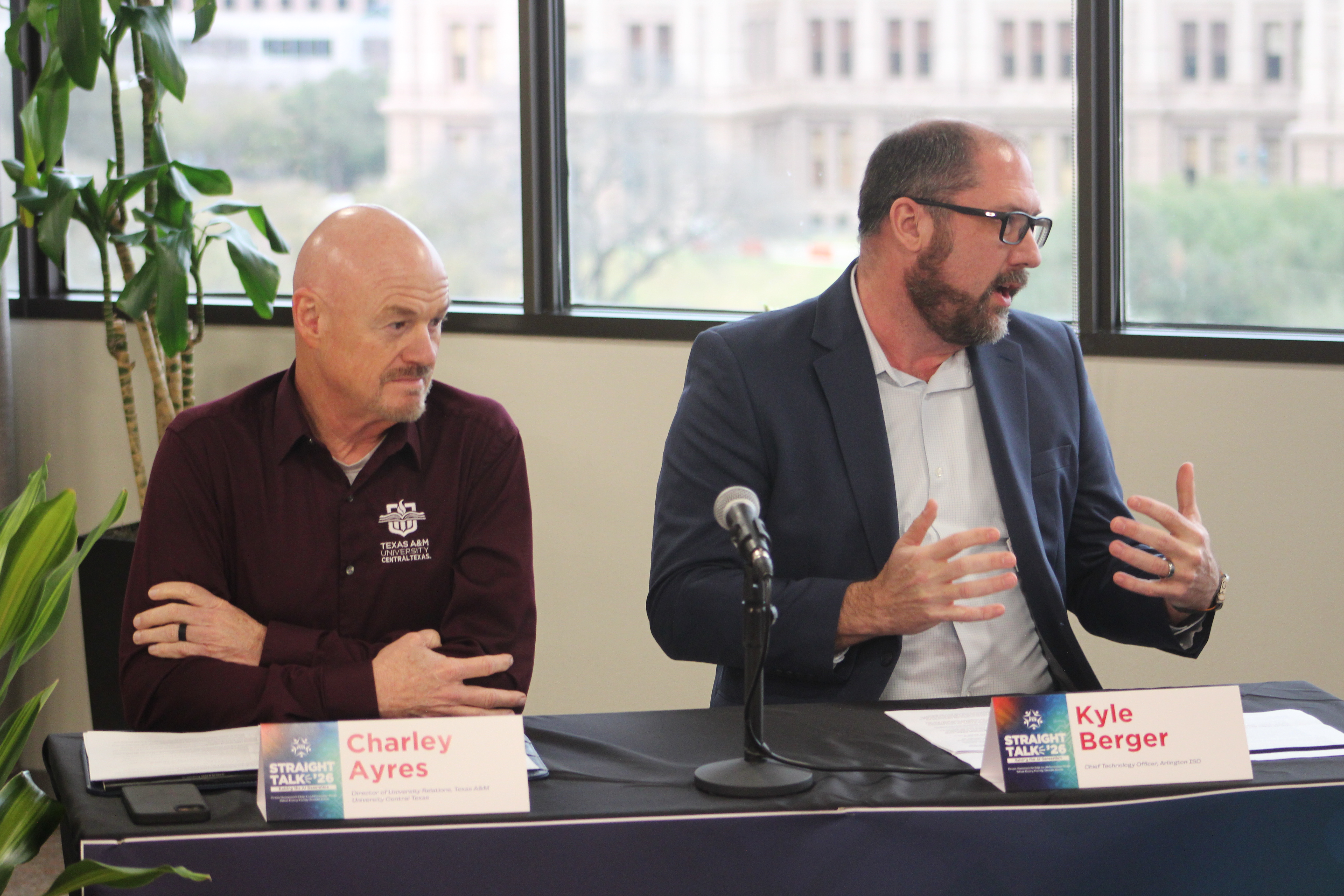
According to Berger, AI use also looks different by grade level.

“In elementary school, primarily what you’ll find is kind of behind the scenes. It’s just kind of invisible to the learner.”

At that level, AI may be built into tools that help teachers adjust instruction based on student needs. Berger said it can also help teachers save time and focus more on the human side of teaching.

“It’s really that tool that empowers [teachers to save time] and give that human teaching aspect back to our students,” he said. “And that’s very important at the elementary level.”

In middle school, Berger said, “this is kind of where it gets tricky,” as students begin interacting with AI more directly and seeing it more clearly in the tools they use.

“Yes, [some students are] attempting to get it to write papers and do some different assignments as well. But teachers are also leveraging it to adjust the [classroom] environment to better support learning.”

By high school, Berger said students are “really digging into deeper research, building out more content and discovery, coding help, and exploring ideas.”

Across all grade levels, that gradual shift prepares students for what comes next by helping them build confidence and responsibility as AI becomes more common in school and beyond.

What do parents most often misunderstand about AI?

Clay Smith, a solutions engineer at Google, said one of the biggest misconceptions is that AI tools know what is true.

“This AI, the generative AI that we experience, it’s math. It’s just math,” Smith said. “One thing I think that people misunderstand is that they think these tools know truth. They don’t know truth. They are predicting based on patterns and context. And so when we use them, we have to make sure that we’re grounding what we’re asking for and what we’re receiving.” 

He also emphasized the importance of verification and critical thinking.

“Without that grounding, we have something called a hallucination. That’s where it makes things up. And so we want to make sure we are double-checking,” Smith said. “We want students to understand that the tool is there to support thinking, not replace thinking.”

How can AI affect children’s well-being and relationships?

Roy Rios, a licensed clinical therapist and director of prevention at the Texas Council on Family Violence, said AI can be useful, but children need to learn how to properly interact with it.

“It can also create confusion if there’s not enough guidance,” Rios said.

He warned that tools designed to feel conversational or relational can affect how children understand connection.

“There can be a tendency to blur the line between real human connection and simulated connection,” he said. In contrast to humans, AI bots are available 24/7 and are built often to affirm and to agree with young people. 
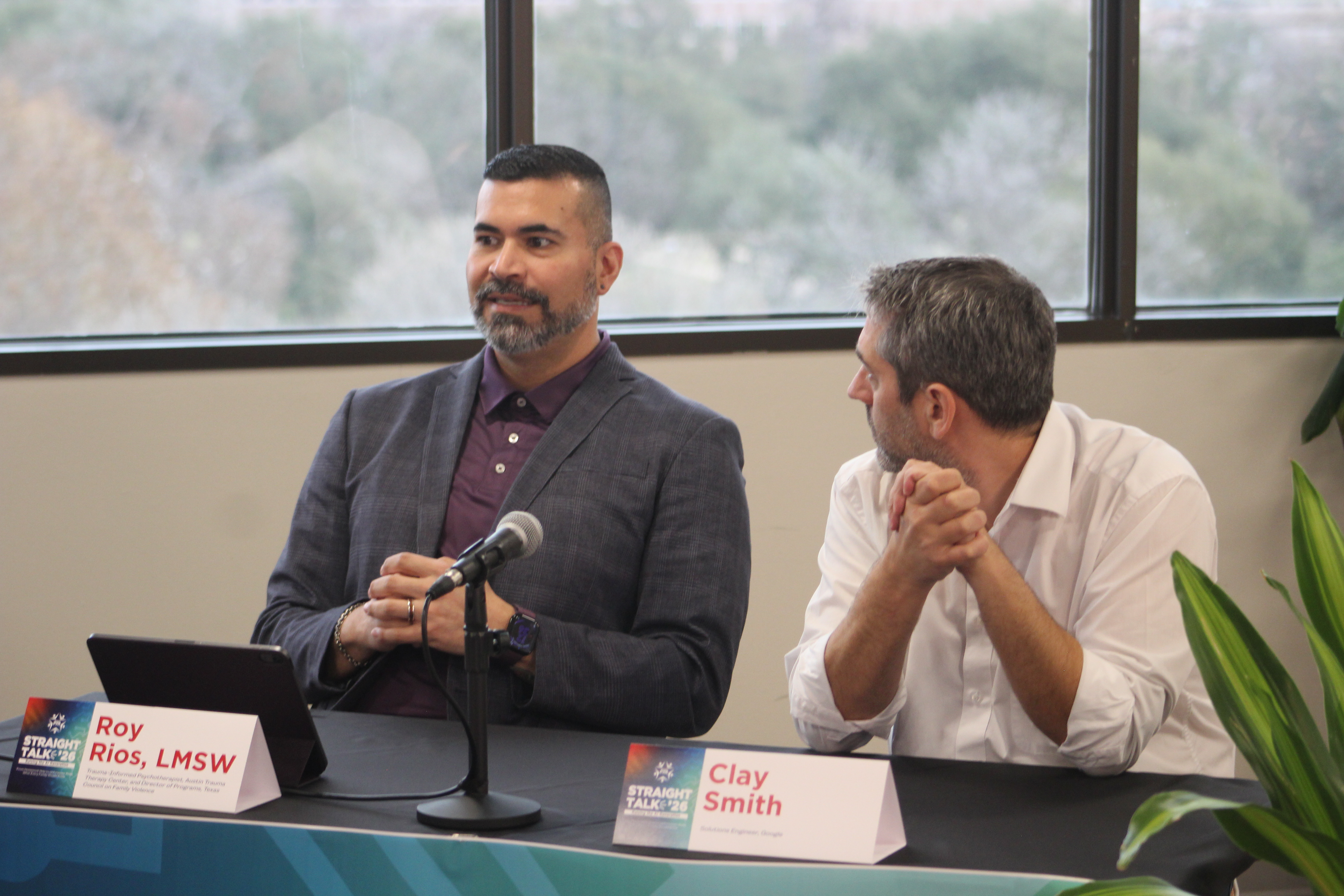
What we see is that if young people are turning to these types of tools regularly, it could skew the development around emotional and social skills.”

Rios said that does not mean the technology itself is bad, but it does mean adults need to stay involved. Because AI can shape perceptions and decision making, young people may not be equipped to understand that information needs to be validated. 

“Deepfakes and other AI-generated content also creates some risk for young people who don’t know how to use it in healthy manners.”

He also offered an important reminder for families: “Overall, what we see is that when greater awareness and conversations are being had around these types of tools, protective factors are greatly increased.”

What should families know about privacy and guardrails?

Berger said schools can build protections into the AI tools they choose, but those protections only go so far.

“There is a big difference between AI in a school setting and … consumer-based AI,” he said.

In schools, many tools operate within what Berger described as a “walled garden,” or closed environment, where districts can better manage access and protections. Outside of school, however, families are often dealing with tools that collect or use information in ways schools cannot control. Awareness matters just as much as school policy.

“It’s all of our jobs to be talking with our students, with each other about AI because we are the best firewall of prevention. It isn’t software. It’s your human mind and how you’re evaluating using the system.”

He encouraged parents to ask practical questions about the tools their children are using.

“What’s the intent? And how is my child expected to use that?” Berger said. “So we can kind of see those bounds and then support our children at home, too.”

The panel also made clear that some of the most important guardrails happen at home. Charley Ayres, director of university relations at Texas A&M University-Central Texas, reminded parents that children are watching how adults use screens and technology.

“Look in the mirror,” Ayres said. “There is such a thing as modeling. They’re being taught at home how to handle the technology. So that’s a critical point.”

As AI becomes more present in school and everyday life, children need guidance in how to question, verify, and use these tools responsibly. AI literacy does not happen overnight. What matters most is helping children build strong judgment, balance, and confidence with any technology they encounter.


Watch the Straight Talk ’26 discussion to learn more about how AI is shaping learning for children and families.




🎉 PTA SPOTLIGHT: Meet Cassie Knapp, Johnson High School PTSA President!

From movie nights to senior breakfasts, this dedicated mom has been creating smiles at Hays CISD schools for over a decade!

“The most rewarding part? Seeing smiles on teachers’, staff’s, and students’ faces,” says our latest PTA spotlight member who started her volunteer journey when her daughter entered kindergarten in 2012 and now serves as Johnson High School PTA President. Here’s the full interview:

  1. How did you initially get involved with PTA? I got involved with PTA when my Senior daughter started kindergarten in 2012. I am a stay-at-home mom and had been involved in the local MOMS Club, so I met lots of women in our community. Our elementary school, Carpenter Hill, PTA president, asked if I wanted to be the Community and Family Partnership Chair. It was a great position. We had movie nights, the Boo/Hoo Breakfast, changed our Family Dance to a Daddy/Daughter Dance and had a Mother/Son Magician Show. Since I was a stay-at-home mom with one daughter, I did as much as I could. I also found out that year I was pregnant with my son, so for the rest of the time my daughter was in elementary school, I ended up volunteering to be a member on numerous committees. Once my daughter went to middle school, I was able to be the fundraising chair. I continued with that at Johnson High School and then became President in 2023. My daughter is graduating this year, but I plan to stay on and keep working with the JHS PTA.
  2. What is your favorite program, activity, or event that your PTA organizes? This is a hard question. I love any time we can give back to our teachers and staff because they are truly the heart of the school, and we appreciate them so much! My other favorite thing we just implemented last year is Senior Breakfast, It is so nice to see how far all the students have come and to be able to provide them with a nice meal on their final day of school. The students are so excited and thankful. It makes all the hard work we do worth it to see the smiles on their faces.
  3. How did you initially build and then maintain a long-term relationship with the school administration? We have several new school administrators this year, including our Principal. We are truly fortunate because our new administration is incredibly supportive of the PTA. We made sure to set up a meeting as soon as we could and let them know our short and long-term goals. They have been fantastic about allowing us to be on campus so we can provide support to our teachers, and we are trying to get the students involved in the JHS PTA as well. It is a work in progress, and we remind ourselves that it takes baby steps and that Rome was not built in a day.
  4. What is the most rewarding part about being involved with your PTA? Seeing smiles on the teachers’, staff’s, and students’ faces. It has been great being able to be on campus this year. We are making long-term relationships, and we can talk to everyone about the importance of PTA to schools. We have been able to share about the advocacy side, which is so important at the high school level.
  5. How do you maintain your energy and motivation?, Support from others on my team, reaching out to the Hays CISD PTA community to get ideas and support, and most importantly my kids telling me how proud they are of me because they see the difference that PTA makes.
  6. Are there any technology tools that you have found particularly helpful? (Mailchimp, Konstella, Social, etc.) How do you leverage them with your audience in mind? I am terrible with technology, but we use FB and Instagram to communicate the most, which works for parents. I am learning how to use Canva, and it is helpful. We are starting to work with students, which makes things much easier since they are much more technically savvy.
  7. Sonic or Starbucks? Sonic for me and Starbuck’s for my kids. Thankfully, they are across the street from one another, but I don’t know that it is great that we know all the baristas’ voices and they know us!
  8.  Do you have a resolution or word for the new year? Perseverance

Thank you, Cassie for volunteering your time, energy and dedication to PTA and ensuring that every child’s potential becomes a reality!

PTA Spotlight: Tuloso-Midway Primary and Intermediate

🎉 PTA SPOTLIGHT: Meet Michelle Holliday, Tuloso-Midway Primary and Intermediate President!

From teacher to powerhouse PTA President, Michelle Holliday shares what drives her passion, how she builds community, and the secret to keeping her energy high (spoiler: it’s not just coffee ☕️).

Q: How did you first get involved with PTA?
💬 “I taught for three years and always knew I wanted to volunteer when I had kids of my own. My youngest started school in 2020—right when volunteering wasn’t an option due to the pandemic. The next school year, a friend asked me to be Treasurer, and I was hooked from day one. Since then, I’ve recruited several other moms to join the journey.”

Q: Favorite PTA program or event?
💬 “Definitely the Warrior Dash! We wanted something outside the box, so we launched a 5K fundraiser (and later added a 1K). We partner with local sponsors and vendors for shirts, medals, and snacks. It’s more than a fundraiser—it’s a celebration of our school and community. People still tell us how fun it was!”

Q: What’s been your secret to building a strong relationship with school leadership?
💬 “I’m a people person, so I made a point to introduce myself to administration early on. I showed up consistently—volunteering, attending events, getting to know staff personally. I even joined the Education Foundation, which helped me build relationships at the district level. A smile and a genuine hello go a long way!”

Q: Most rewarding part of PTA involvement?
💬 “The kids’ faces! Whether it’s delivering hot chocolate at Christmas or reading to Pre-K during Read Across America Week, those moments are unforgettable. It means so much when students recognize me in the hall and light up.”

Q: How do you stay energized and motivated?
💬 “People ask me that all the time. I’m a wife, mom, business owner, and full-time employee—you just get things done! Coffee helps, but really, it’s the people I serve with. The moms and dads on our board are incredible, and many have become lifelong friends. That support system keeps me going.”

Q: Any tech tools that help?
💬 “Technology is my kryptonite! If it’s not Word or Excel, I’m lost. Thankfully, my VP and Communications Chair are Canva wizards and make us all look good. I do use MyPTEZ for membership and might explore the paid version soon.”

Q: Sonic or Starbucks?
💬 “Oh… toughest question yet! Sonic.”

Q: What phrase is keeping you going through the end-of-year chaos?
💬 “Just keep showing up. It doesn’t have to be perfect—I may not stay for every event—but I give my best effort where I can. I remind my board: you don’t have to do everything. We’re a team, and together, we make it happen.”

Michelle’s dedication is making a difference every day with Texas PTA!

💫 SPOTLIGHT: Meet Julie Barschow, PTA President at Carpenter Hill Elementary, Hays CISD! 💫

Julie’s journey with PTA began when her son started kindergarten, and she noticed parent involvement challenges at his school. “I offered to jump in and learn how to help, then the rest is history!” she shares.

How did you initially get involved with PTA?

When my son started kindergarten at Joslin Elementary in AISD, I learned quickly that parent involvement was a challenge and that the PTA was made up mostly of teachers who were also parents. I offered to jump in and learn how to help, then the rest is history! 

What is your favorite program, activity, or event that your PTA organizes?

Tough question! PTA does so much, it’s hard to choose. One of my favorites for my current PTA (Carpenter Hill Elementary in Buda) is Grants & Scholarships. We raise and distribute funds for continuing education/professional development for teachers and for equipment, supplies, or other items needed for classrooms. 

How did you initially build and then maintain a long-term relationship with the school administration?

I attend events that the Principal/administration hosts, and make a point to connect with the Principal, school leadership, etc. I communicate regularly, while being mindful of their workload and be sure to follow through with all promises. Once the faculty and staff understand the PTA is there to support them (and hopefully spoil them sometimes!), and help students thrive, they will be willing partners and participants in your work. 

What is the most rewarding part about being involved with your PTA?

The most rewarding part about being involved in PTA is the tight community it creates between parents, kids, and teachers/staff. Enriching students’ educational experiences, facilitating acts of love and appreciation for teachers and staff, and building friendships are all very rewarding. 

How do you maintain your energy and motivation?

I maintain my energy and motivation by remembering to pause, breathe, pray, meditate, and get outside as much as possible. We cannot pour from an empty cup, so I am intentional about keeping in good physical, mental, emotional and spiritual health with consistent daily practices. 

Are there any technology tools that you have found particularly helpful? (Mailchimp, Konstella, Social, etc.) How do you leverage them with your audience in mind?

PT Board has been a great communication tool for our PTA. Canva is also a lifesaver for graphic design! Canva is excellent for users of any level to produce graphics for things like flyers and social media. Our Principal is also amazing and will send what we call One Message Emails, which get the best view and response rates. To break through the business and noise, Say One Thing and give one Call To Action. 

Sonic or Starbucks?

Starbucks 100%. 

Do you have a resolution or word for the new year?

I don’t have a resolution or words for this new year, however, these are the phrases that guide my days: “In Harmony with God” and “Love is an Action.” 

Texas PTA Gears Up for Rally Day 2025: Advocating for Texas Students

On February 24, 2025, parents, educators, and advocates from across Texas will unite at the State Capitol in Austin for Texas PTA’s biennial Rally Day. This powerful event provides a platform for PTA members to meet directly with legislators and champion public education.

A Day of Advocacy and Action

Rally Day 2025 is more than just an event—it’s a movement. With major decisions being made on school funding, teacher retention, and student safety, the voices of PTA members are more crucial than ever.

“Rally Day represents the heart of PTA advocacy – parents and educators coming together to make real change for Texas children,” said Jennifer Easley, Texas PTA President. “With crucial decisions being made about school funding, safety, and teacher retention, our members’ voices are more important than ever.”

The event will include face-to-face meetings with state lawmakers, advocacy training sessions, student performances, and a rally on the Capitol steps. Attendees will also witness the recognition of outstanding PTAs making a difference in their communities.

Bipartisan Support for Education

This year’s Rally Day will feature a diverse panel of bipartisan leaders who share a commitment to Texas schools, including:

  • State Representative Alma Allen (D)
  • State Representative Brad Buckley (R)
  • State Representative Drew Darby (R)
  • State Representative Gina Hinojosa (D)
  • State Representative James Talarico (D)
  • State Representative Jay Dean (R)
  • Senator Nathan Johnson (D)
  • Texas Commissioner of Education Mike Morath

Their participation underscores the shared responsibility of ensuring a bright future for Texas students.

Key Legislative Priorities for 2025

Texas PTA is committed to advocating for legislative changes that directly impact students, teachers, and families. This year’s priorities include:

  • Improving public school funding by shifting to an enrollment-based model
  • Addressing teacher and staff shortages to maintain quality education
  • Enhancing school safety measures to ensure student well-being
  • Transforming school accountability systems for fair and effective evaluation
  • Protecting public education funding from being diverted to other initiatives

With more than five million students in Texas public schools, these issues are at the forefront of Texas PTA’s advocacy efforts.

Be Part of the Change

Rally Day is an opportunity for every PTA member, parent, and educator to make a difference.

“Every parent and community member who joins us at Rally Day strengthens our collective voice for Texas children,” said Rachel Abell, Texas PTA Vice President of Advocacy. “Together, we can ensure our legislators understand the real impact of their decisions on our classrooms and communities.”

Event Details

  • Date: February 24, 2025
  • Time: 9:00 AM – 4:00 PM
  • Location: Texas State Capitol, Austin, Texas

Join Texas PTA in making a lasting impact on public education. To register and learn more, visit Texas PTA’s website. Let’s raise our voices together and advocate for a brighter future for all Texas students!